I Can’t Fill This Job!: Filling IT Talent Gaps

CIOs are having a hard time finding good candidates for open positions. They’re not alone.

According to ManpowerGroup’s annual survey, 52 percent of employers in the US are struggling to fill mission-critical positions. The number of employers experiencing difficulties is at an all-time high, despite a high unemployment rate.

So, what should a CIO do? Keep searching as current employees become more frustrated because they’re overloaded trying to cover extra work? There’s another way.

Get the Kinks Out of the Acquisition Cycle

The first thing to do is to sharpen the acquisition process. Talent acquisition is a notoriously leaky process. Companies lose money through slow screening, ineffective matching, and incorrect selection processes.

IT Talent: Technology Leaders with People Problems

Squirrels are great at foraging for nuts, building nests, and finding ways into my “squirrel-proof” birdfeeder (that’s not a picture of my personal birdfeeder, but it gives you the idea). But they’re never going to be great swimmers. Similarly, some leaders are never going to be great at managing people. So what do we do?

Goodbye Manager, Hello Individual Contributor

The most obvious answer is to shift poor people managers into individual contributor roles. With this solution, people aren’t forced to do something they can’t do well. At the same time, the company doesn’t lose their knowledge and experience.

There are two problems, however.

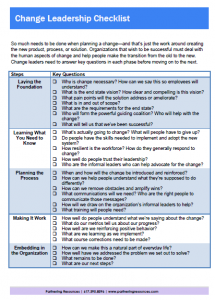
Change Leadership Checklist

It's a holiday week in the US so, for this blog post, here's a gift: a downloadable checklist to help you think through your next change effort. Happy holidays!

So much needs to be done when planning a change—and that’s just the work around creating the new product, process, or solution. Organizations that wish to be successful must deal with the human aspects of change leadership and help people make the transition from the old to the new. Change leaders need to answer key questions in each phase before moving on to the next. Use this simple checklist to see if you've answered the important questions about your next change initiative.

Who You Calling Virtual? Leading a Virtual Team

Let’s get one thing out of the way: there’s no such thing as a virtual team. They’re only called virtual teams because members are distributed across organization boundaries, time zones, and countries. And the virtual piece isn't the problem at all. It’s a red herring.

People like to blame their problems with dispersed teams on the technology. They complain: “The WebEx froze halfway through our session” or “All I can hear is buzzing on the conference line.” Yes, these are problems. But, dear readers, many of you are tech people. You can figure it out.

Networking for Introverts: A Starter List of Tips & Techniques

I recently wrote about how we need to rethink networking: what it is and why we do it. I confessed that I am, in fact, an introvert and that I force myself to get through large-scale, cocktail-style, traditional networking events. I shared my belief that we need to network differently, particularly those of us who are introverts.

A Starter List: Networking for Introverts

What are some networking techniques that are well suited to introverts’ styles? Here’s a quick list.

Share a link, article, or report that you think will interest a specific person. I have a list of my top ten connectors: people who have gone out of their way to connect me to others.

Rethinking Networking

Maya's LinkedIn Network

Why do we network? It’s an important question that most of us don’t consider. I didn’t until I started my business in 2004. People told me that networking would be an important way to build my practice. I agreed and started going to traditional, cocktail-style, business card passing events.

I’m a bona fide introvert. What that means is that, at the end of a standard networking event, I’m exhausted and want to curl up by myself with a book for a few hours. Traditional networking was something I forced myself to do, usually by gritting my teeth, setting a simple goal like “Meet two new people and then you can go home,” and soldiering through the experience.

Illuminating the Invisible: Mapping Austin’s Adolescent Health System Using Value Network Analysis

I’m delighted to announce that has published an article on the work done last year with the Austin Healthy Adolescent Initiative. “Illuminating the Invisible: Mapping Austin’s Adolescent Health System Using Value Network Analysis” provides a case study of how we used a specific technique to paint a holistic picture of how the system works from service provider and youth perspectives.

Here’s an excerpt from the beginning of the article:

In Austin, Texas, a diverse group of people—service providers, funders, and policy makers—came together to improve adolescent health. They ran into a critical issue: the adolescent health system was so complex, multifaceted, and dynamic that it resisted traditional analytical approaches.

How to Help Managers Lead Change in CIO Magazine

We're undergoing significant change and I can't be everywhere. How can I help my managers lead?

If you're struggling with how to help your direct reports lead change, you're not alone. CIO Magazine readers, check your October 15, 2012 issue on page 12 for thoughts on what leaders can do to help their managers with change leadership. In the column, we cover:

  • How to keep managers on track when clients pull their focus
  • What to do when managers are strong technically, but haven't developed strong people skills
  • How to handle local experimentation during change

Being Better: Strategic Leadership for Business Ecosystems

If you live in a regulated monopoly, feel free to skip this post and go play golf. For the rest of you, here’s something important that you probably need to hear again:

  • Today’s successes are not individual successes. They’re collective successes.
  • Today’s businesses are not single entities. They’re part of complex ecosystems.
  • The methods you learned in business school are probably not helping you (unless you had some really hip professors).

What does this mean?

First: If you’re someone who gets more energy from doing it all yourself than from working through others, you probably shouldn’t be leading people. People used to talk about the shift from managing yourself and managing others.

“If Everyone Jumps, Do You Jump Too?”: Using Social Ties for Change Leadership

It’s 1981 and I want nothing more than to own a pair of designer Jordache jeans. My mother thinks they’re too expensive. “But,” I complain, “All of my friends have them.” Her response: “If all of your friends were jumping off a cliff, would you jump too?”

That was my first lesson in the importance of resisting peer pressure. (It didn't stick, by the way. I eventually wore down my mother. In my jeans, I thought I was the coolest kid in town.)

My views on peer pressure are a little more nuanced today than it was in 1981. Today, I believe that social pressure has power that can be used for good.

Is your strategy stuck in the 20th century?

Image of "Is Your Strategy Stuck in 20th Century"

Sign up to receive the two-document Strategic Resilience set and join our low volume list.

We’ll never share your information with anyone. Period.

* - required