Trust Falls at Work… Seriously? Trust in the Workplace

trust_fall_rosscreations

I talk with a lot of people about networks. I tell them that, at the very root of the matter, networks are about trust. We build relationships with people we trust in order to solve problems, get things done, and imagine what could make our companies successful and the world a better place.

When I have these conversations about trust, one group of people nods. They intuitively understand the importance of being able to trust your colleagues.
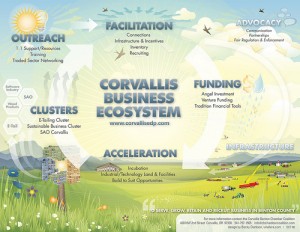
Visions of Business Ecosystems

Corvallis_Business_Ecosystem

Incredible complexity. So many moving parts. Almost impossible to fully understand and depict. These are all descriptions of business ecosystems. Yet people continue to try to understand the big picture—their environment—and how it affects their companies. There’s good reason to do so. If companies can improve their understanding of their ecosystem, they have an edge that can help them find opportunities, assess potential threats, find collaborators, and monitor trends. In this post, we’ll look at a few different ways organizations depict and understand their business ecosystems.

The Corvallis Business Ecosystem

How do you get politicians, business owners, programmers, and staff members on the same page?

Think Before You Assess: Tips for Your First Network Analysis

Jazzed about doing your first network analysis? Hold your horses! It’s important to do no harm when conducting a network analysis. Make sure to read these important caveats before you begin.

Identify Your Goal

Determine what you want to learn as a result of conducting a network analysis. Do you want to identify influencers (critical connectors) in order to engage them in change initiatives? Do you want to understand how information flows through the organization? Do you want to create a plan to help new employees build their networks during the on-boarding process? The questions you choose will shape the results you receive, so be clear up front.

The Forest and the Trees: Managing in Business Ecosystems

Spring Forest
When I was a kid, one of my favorite things to do was to hike with my parents. We would romp through forests, looking at interesting lizards and trees, finding animal tracks, and admiring the sounds of bird calls. We would arrive at our destination, usually the top of some peak. We'd get to look at the entire forest -- the trails we followed, the lakes we missed, the cloud formations -- and we'd feel awed and satisfied. We had been in that forest, but now we could see it from above.

Just Published: Using Business Ecosystem Mapping to Navigate Complexity

Excerpt from “Finding Value”: an article just published by OD Practitioner.

Several years ago, I was hired by a software client to help with strategic planning. When the company started fifteen years ago, its product was revolutionary but its uniqueness was not a permanent state. Other companies were offering software that provided similar functions. The channel partner who sold the company’s software was now offering a competitive product. Furthermore, hardware companies were embedding the software’s features into devices like printers, scanners, and faxes. This company needed help figuring out how to move forward amidst these challenges.

Eight years later and 2000 miles away, a diverse group came together to improve the health of adolescents in Austin, TX.

I’ve Got Your Back: Trust at Work

A fellow blogger, Charlotte Erdmann, recently wrote that the future of work will be more flexible and more networked. She’s right on.

What caught my eye in her article was the word “trust.” Charlotte mentioned it three times. No wonder: In a world in which information flows much more freely and people collaborate more frequently than in the past, trust is essential.

Unfortunately, trust is also elusive. Over the past several years, I’ve worked with a variety of clients on issues such as strategy, change, and leadership. It doesn’t matter what I’m overtly doing with the client. Trust always comes up.

Networking or Marketing: How to Escape the Advertising Trap and Get Real

Several weeks ago, I fell into a network trap. I asked someone for her business card without getting to know her first. We were at a networking event so it wasn’t rude or unexpected. She gave the card to me although I could tell she wasn’t thrilled with me or my request.

People do this all the time. They exchange cards with acquaintances and then go back to the office and file them. Perhaps they add them to their emailing list and then they congratulate themselves: “Wow! I’m up to 1000 people on my email list. I’m hot stuff!”

The problem is that there is a big difference between developing genuine networks and advertising.

Getting Ahead of the Curve: Workforce Planning to Anticipate Talent Gaps

Mind the Talent Gaps. Image by limaoscarjuliet on flickr.

People have been predicting boomer brain drain for years. In 2008, a SHRM / AARP study warned about the impending brain drain. Yet, companies haven’t been too worried, partially because the economy has made it impossible for people to leave.

It might be time for that relaxed attitude to change.

Recently, one of my clients was surprised to learn that 28% of their workforce would be eligible to walk out the door with full benefits within the next two years. That’s a lot of people and a lot of institutional knowledge. With the market in recovery, they decided it was time to act.

Hate Small Talk? Here’s How to Make It Work For You

“Small talk can get big results — but only if you know how to use it,” says Robin Madell on Glass Hammer. Unfortunately, too many of us don’t know how to use small talk. We shy away from networking meetings where we’ll need to use it and cringe as we ask someone about the weather. Yet, small talk has a very important purpose. Learn about that purpose in this article, which features Maya Townsend of Partnering Resources and Dr. Robin Bernstein of Harvard University.

An Open Letter to Project Managers, the New Rock Stars

Project Managers are Rock Stars!

First things first: Project managers rock. You grease the wheels, pacify the resisters, solve impossible problems, and keep things going when everyone else wants to quit. You save our butts every day, and I thank you for it.

Here's the thing, though. You're shooting yourselves in the foot with the heroics. Yes, it's fun to play Superman or Superwoman and fly in at the 11th hour to save the day. You get that adrenaline high, and you feel like the company couldn't survive without you. Indeed, it can't.

That is, of course, why it's time to change.

Is your strategy stuck in the 20th century?

Image of "Is Your Strategy Stuck in 20th Century"

Sign up to receive the two-document Strategic Resilience set and join our low volume list.

We’ll never share your information with anyone. Period.

* - required