Three Networking Types: People You’ll Meet while Searching For Your Next Job

At Partnering Resources, we prefer to talk about networking as an ongoing activity, not just as something people do when they need a new job. But we do use our networks for job searching and, in this guest post by Irene Brank, we learn about three types of people that we meet while networking for a new job.

In today’s job market, we are all temporary employees, contractors if you will. It is vitally important that we keep active networks, but even more important to know “who they are” when you need them. As I’ve entered the world of job seekers after a beautiful career of over 25 years, I’ve learned some valuable lessons about the people I’ve acquired in my network over the years.


How to Network in a Professional Association

If you're like most people, you belong to one or two professional associations. These organizations are supposed to serve serve as your networking and education hub. You go to meetings, learn interesting things, keep up with your profession, and expand your professional network... supposedly. However, many feel disappointed by their experiences with professional associations. Here are a few tips to help you get the most from your money.

How to Network at a Social Event When You Don’t Know Anyone

Social events can be extremely anxiety-provoking for introverts. Walk into a room where I know no one? Make small talk over canapés? Can’t I just hide in a corner instead? Never fear, introverts: we can do this. Here’s how to network at a social event.

Prevention is key

Before you go to an event, try to identify who else will be there.  If you know people who plan to go, you can plan to meet there.  Email people ahead of time and make plans. Introverts do better with structure. If you’re entering an unstructured environment, see if you can create some planned events or tasks for yourself so the event isn’t totally unstructured. The best way to create structure is in advance.

How to Network From Your Desk (For Introverts and Busy People)

It can be hard for introverts to do a lot of the activities normally considered to be networking, especially the large group meet-and-greets. It can also be tricky for those who are busy or those who hate networking. How do you find time to build and sustain your network? Here’s a quick list of easy ways you can network from your desk.

Share Content

Share a link, article, or report that you think will interest a specific person. I have a list of my top ten connectors: people who have gone out of their way to connect me to others. I know their interests, hobbies, and future goals.

Highlights of The Build Network Conference in Boston

Make Change Stick

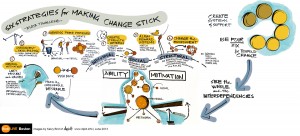
In June, eighty leaders of mid-sized companies convened at the Build Network conference in Cambridge, MA. The highlights (besides an incredibly enthusiastic, engaged audience that make my presentation on “Six Strategies for Making Change Stick” a ton of fun) were:

  • Dan Ritzenthaler (@danritz) and Nelson Joyce (@nelsonjoyce) of HubSpot (@HubSpot) talking about a technique they picked up from Google that makes every meeting better. Called “Always Be Capturing,” it centers on capturing all thoughts, timelines, issues in meetings. If it’s not worth capturing, it’s time to move on. Dan and Nelson said that this simple technique reduced conflict and accelerated design from months to five days in a recent intensive session with Google.

Setting the Right Pace for Change

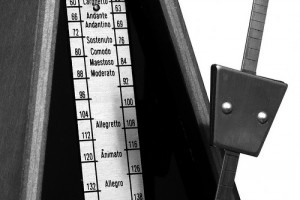
Metronome by Nigel Appleton

In a recent post, we explored the value of go slow to go fast. This idea suggests that, if we slow down at the beginning of a change initiative to engage stakeholders, gain clarity on goal and target outcomes, and work through tough issues, we can speed through implementation. On the other hand, if we choose to go fast up front, we risk setting ourselves up for frustration and firefighting by neglecting beneficial relationships and issues.

We can choose our pace. Some changes need to move quickly, others slowly. This post covers two fundamental questions: When should we go slow? How slow should we go?

Maya Townsend Presents on Change Strategy at The Build Network

Maya Townsend of Partnering Resources presents “Six Strategies for Making Change Stick (HINT: Connections Matter!)” in July at the 2013 Build Boston SOLVE! Session. Here’s how Build describes the change strategy session:

Challenge: To get better, we have to evolve — but only 38% of leaders say their change efforts have actually improved performance. Why is it so tough to win buy-in and make change stick?

Solution: Change by dictum doesn’t work. The only thing that does: connections, and lot of them. Studies show that effective change makers simultaneously employ these six strategies for building the individual, social, and structural connections that make transformation excite — and, therefore, take hold within — an organization.

Go Slow to Go Fast: Make Your Next Change Initiative Fly

Tortoise_and_Hare

Ah, the satisfaction of getting things done. Like many others, I have a very long “to do” list. Nothing makes me happier than whittling down that list or knocking off the last item of the day.

But in the rush to get things done, it’s important that we take time to set ourselves up for success. Sometimes, we have to go slow to go fast.

Why Go Slow?

Fast gets things done quickly… sometimes. Slow helps ensure that we get the right things done quickly.

Say we’re leading a mission-critical, fast-track project within our company. It represents a major change in how people operate, and it’s tied to a new corporate strategy.

Building Your Network: How to Make It Work with Your Boss

collaboration at work

Is your biggest networking problem your boss? Read this article for tips and techniques on how to network with your boss.

The relationship with your boss is one of the most important in the workplace. Your boss has the power to recommend you for new assignments, high-profile teams, promotions, and raises. She can make your life miserable or help you achieve your goals. Yet, despite the importance of this relationship, there are many more books on how to manage direct reports than how to manage bosses. This article explores four factors—style, context, relationship, and urgency—to consider before giving up on the relationship with your boss.

The Power Five: Better Decisions through Strategic Questions

strategic questions

People are always looking for their magic wand: a miraculous tool that will immediately and painlessly improve the problem at hand. I haven’t found a magic wand yet. But this tool is the closest I’ve found so far.

The Power Five are five strategic questions that uncover expectations, assumptions, inter-dependencies, and impacts. They’re five of the best questions to use in any situation and bringing them into any decision-making, strategy, or planning conversation will improve the likelihood of a positive outcome.

The five questions are:

  • What is the goal?
  • Where are we now?
  • How will we get where we want to go?
  • Is your strategy stuck in the 20th century?

    Image of "Is Your Strategy Stuck in 20th Century"

    Sign up to receive the two-document Strategic Resilience set and join our low volume list.

    We’ll never share your information with anyone. Period.

    * - required